From Investment to Legacy: Why Multifamily Real Estate is the Secret to Long-Term Financial Success
Key Points Covered In the eBook

Table Of Contents
- Introduction: Unlocking the Power of Multifamily Real Estate
- Chapter 1: Multifamily Real Estate and Legacy Building
- Chapter 2: Why Multifamily Real Estate is Steady, Recession-Resistant, and Tax-Advantaged
- Chapter 3: How To Get Involved in Multifamily Investments
- Chapter 4: Case Study – Ryan Tseko: Transforming Real Estate into a Multi-Million Dollar Legacy
- Chapter 5: ApexStone Capital - Your Partner in Multifamily Real Estate Investment
- Conclusion: Securing Your Financial Future Through Multifamily Real Estate
- Introduction
- 1. MF & Legacy Building
- 2. Benefits Of MF
- 3. Invest In MF
- 4. Case Study
- 5. ApexStone Capital
- Conclusion
Introduction : Unlocking the Power of Multifamily Real Estate
Building wealth that stands the test of time and can be passed down through generations is the ultimate financial goal for many people. However, achieving this requires more than just smart savings or investment strategies—it requires the right type of assets. Multifamily real estate has proven itself to be one of the most powerful vehicles for wealth creation, offering consistent returns, significant tax advantages, and the opportunity to create a legacy that can provide financial security for your family for generations.
This eBook will show you how multifamily real estate can be your ticket to building that lasting legacy. We’ll walk you through the benefits of multifamily investments, how they weather economic downturns, and how they fit into your larger strategy for legacy building.
Ready to get started on your legacy journey?
Schedule a free call with us to explore how multifamily real estate can help you achieve your goals!
Chapter 1 :Multifamily Real Estate and Legacy Building
Understanding Legacy Wealth
Legacy wealth isn’t about simply saving money—it’s about creating a system that provides financial freedom for your heirs, even after you’re gone. It’s a way of passing down both tangible assets (like property) and intangible assets (like the principles of wise investing) to future generations. The goal is to ensure that your family is well-equipped to thrive without starting from scratch.
The Role of Multifamily Real Estate in Legacy Building
Multifamily real estate is a powerful tool for legacy building because it generates passive income, appreciates over time, and is relatively less affected by market volatility. Unlike stocks or other single family investments, multifamily properties offer investors the ability to generate steady cash flow, scale their investments, appreciate in value, and diversify their portfolios.
-
Steady Cash Flow:
With multiple rental units, even during times when a unit is vacant, the remaining tenants still contribute to your income stream. This ensures reliable cash flow, an essential component for long-term wealth building. -
Scalability and Long-Term Growth:
Starting small, you can scale your multifamily portfolio by acquiring more units over time. As your portfolio expands, your cash flow does too, making it a reliable source of wealth-building. -
Appreciation of Value:
Multifamily properties generally appreciate in value over time, due to increasing rental demand from lack of affordable housing, CapEx improvements and effective property management operation.
Types of multifamily acquisition
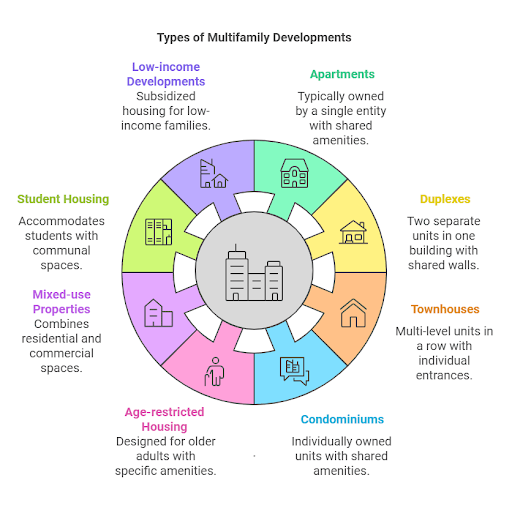
In addition to traditional multifamily properties like duplexes, townhouses, condos and large apartment complexes, there are several other types that can diversify and strengthen your portfolio. Low-income developments provide subsidized housing, ensuring steady demand, while student housing near universities offers strong rental yields. Mixed-use properties combine residential and commercial spaces for diverse income streams, and age-restricted housing caters to seniors with specialized amenities, attracting a reliable demographic.
These property types offer unique opportunities for a resilient and diversified real estate portfolio.
Multifamily real estate is about more than just individual properties; it’s about creating a legacy—a sustainable, growing source of income that supports not just you, but your family and future generations.
The U.S. multifamily real estate market in 2025 is projected to experience a period of stabilization and modest growth, influenced by several key factors:
-
Rent Growth:
National rent growth is expected to recover gradually, reaching approximately 4% by 2026, as the supply of new units slows and demand stabilizes . Read More -
Investment Activity:
Despite economic uncertainties, investor confidence remains, with a projected increase in multifamily transaction volume to approximately $370 billion to $380 billion in 2025 .Read More -
Multifamily New Construction Slowdown:
In 2025, rising costs from inflation and tariffs on building materials have slowed new multifamily construction. The NAHB reports that these costs have increased construction expenses by $9,200 per home, while high interest rates further strain budgets. As a result, fewer new units are entering the market.
This slowdown has increased demand for existing multifamily properties, driving up values and rental prices. For investors, this presents a strong opportunity, as established properties offer immediate cash flow, lower risks, and faster returns compared to new developments.Read More
Chapter 2 : Why Multifamily Real Estate is Steady, Recession-Resistant, and Tax-Advantaged
Multifamily Real Estate: A Stable Investment in Unstable Times
Building generational wealth is about creating a stable, scalable foundation that endures through tough times. Multifamily real estate is a proven, reliable asset class during economic uncertainty.
Unlike volatile stocks or bonds, it offers consistent cash flow, long-term appreciation, and powerful tax-saving strategies—key elements for building a lasting financial legacy.
Multifamily as a Hedge Against Inflation and Economic Volatility During times of inflation and economic downturns, multifamily real estate often serves as a safe haven. Rent tends to rise with inflation, and the steady demand for housing provides stability even in volatile markets.
Why Multifamily Real Estate is Recession-Resistant
-
1. Consistent Demand For Housing:
The primary driver behind the stability of multifamily real estate is the consistent demand for rental housing. Regardless of economic cycles, people need places to live. Whether due to high homeownership costs, lifestyle changes, or economic downturns, people will continue renting. This makes multifamily properties a great hedge against market uncertainty.
-
Example: Even during tough times like the Great Recession—when the economy shrank over 4% and unemployment soared to 10%—multifamily properties showed remarkable resilience. While vacancy rates edged up slightly from 6.8% to 7.8%, and rent growth dipped temporarily, multifamily investor returns stayed strong, with only a modest decline to -8.3% in 2008.
Fast forward to the COVID-19 recession, and multifamily once again proved its strength, maintaining positive rent growth overall despite the challenges. These stats underscore why multifamily real estate is a rock-solid, recession-resistant investment you can count on—even when the market gets shaky. Read More
-
2. Diversification:
-
Risk Reduction:
Multifamily properties, by nature, provide a wide range of income sources. With multiple tenants paying rent, your income is spread across several units, making your investment less susceptible to vacancies or tenant turnover. In addition to traditional rent, property owners have the freedom and flexibility to create additional income streams, such as charging for pet fees, covered parking, and laundry services, which further diversify their income sources and boost overall profitability. -
Tenant Profile Diversification:
Adds an extra layer of security. Multifamily properties attract tenants working in various industries, which helps to reduce the risk of vacancies caused by an economic downturn in a specific sector. If one industry faces job losses, tenants from other sectors—such as healthcare, education, or tech—can continue to afford their rent, ensuring a steady income stream for property owners. This diversification in tenant profiles further strengthens the stability and growth potential of your multifamily investment. -
Geographic Diversification:
One of the key advantages of multifamily real estate is the ability to geographically diversify your investments. By investing in properties across different markets, you can mitigate risks from localized economic downturns. Diversifying your multifamily real estate portfolio ensures that your legacy is built on a solid, resilient foundation that can withstand economic fluctuations and continue to grow for generations.
-
3. Forced appreciation:
Forced appreciation occurs when a property's value increases due to strategic improvements, rather than relying solely on market conditions. Effective property management plays a key role in this by boosting Net Operating Income (NOI).
-
How Appreciation Works:
The S&P CoreLogic Case-Shiller Home Price Index shows that U.S. home prices have more than tripled from January 2000 (index level 100) to February 2025 (index level 335.08), reflecting an average annual appreciation of approximately 4.8%. This long-term growth highlights real estate’s ability to provide investors with sustained value appreciation over time, despite short-term market fluctuations.Read More -
Market Demand and Growth:
Multifamily properties typically see an increase in value as the demand for housing in certain areas grows. Properties located in high-demand markets tend to appreciate more quickly, increasing the value of your investments. -
Forced Appreciation:
In addition to natural appreciation, multifamily properties can also benefit from forced appreciation—value increases from improvements or operational efficiencies. By upgrading amenities or raising rents in line with the market, investors can significantly increase the value of their properties. By improving tenant management, reducing vacancies, and enhancing amenities, the owner of the property can increase income and control costs. This higher NOI makes the property more attractive to buyers, driving up its value through forced appreciation, regardless of market trends.
Tax Advantages and Benefits for Multifamily Real Estate Investors
In addition to the stability and cash flow offered by multifamily properties, tax-saving benefits are a major advantage. Real estate investments come with several strategies that allow you to reduce your taxable income and maximize your wealth-building potential. These tax benefits not only help you grow your wealth during your lifetime but also ensure that future generations inherit that wealth in the most tax-efficient manner possible.
-
1. Cost Segregation:
Cost segregation is an advanced tax strategy that allows investors to accelerate depreciation by breaking down the property into smaller components with shorter depreciation periods (5, 7, or 15 years instead of 27.5 years). This means that you can claim larger depreciation deductions in the early years of ownership.
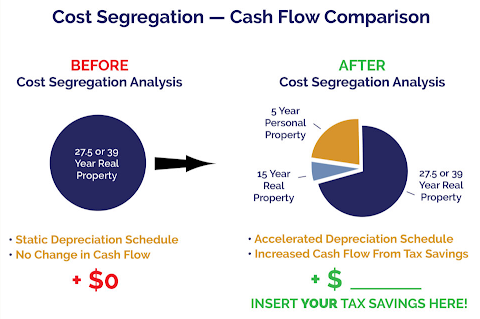
In a cost segregation study, you can accelerate depreciation on certain property components, leading to greater tax savings.
For example:
- Without Cost Segregation: A $1.5 million apartment complex has $54,545 annual depreciation over 27.5 years.
Cost segregation is a powerful tax strategy used by real estate investors to accelerate depreciation on certain components of a property. This allows investors to write off more of the property’s value in the early years of ownership, which can lead to significant tax savings and enhanced cash flow.
Step-by-Step Breakdown
-
A. Identifying Components for Accelerated Depreciation:
In the example, the investor uses cost segregation to identify components of this $1.5M property that can be depreciated over a shorter period of time. Instead of depreciating the entire property over 27.5 years (the standard for residential real estate), certain assets like appliances, HVAC systems, flooring, and landscaping are broken out and depreciated over a much shorter period — typically 5, 7, or 15 years.
-
Identifying $300,000 in components:
In this case, the investor identifies $300,000 worth of components in the property, such as appliances, HVAC units, and other non-structural items.
-
B. Depreciation Calculation for the First Year:
-
First-year depreciation:
These components, like appliances and HVAC, can be depreciated over 5 years instead of 27.5 years. Therefore, the first-year depreciation for the $300,000 worth of components is calculated by dividing it by 5 years. First-year depreciation=300,000/5=60,000 So, in the first year, the investor can deduct $60,000 from taxable income for these components alone
-
C. Depreciation for the Rest of the Property:
-
Remaining Property Depreciation:
The rest of the property (land, structure, and long-term components) is typically depreciated over 27.5 years, but the cost segregation study also accounts for a portion of the property that can still be depreciated in the same year. In this case, the remaining depreciation for the rest of the property is $32,727 ($1.5M – $300,000 from components spreading across 27.5 years).
Therefore, $92,727 ($60,000 from components + $32,72 from the rest of the property) in depreciation can be claimed in the first year.
-
D. Tax Savings Impact:
Now, let’s calculate the tax savings based on the depreciation:
- Tax bracket: The investor is in a 30% tax bracket.
- Tax savings calculation: Depreciation directly reduces the investor’s taxable income. With $92,727 in depreciation, the investor can reduce their taxable income by 27,818.10 (92,727×30%).
-
2. Bonus Depreciation:
One of the most powerful tax-saving strategies for multifamily real estate investors is bonus depreciation. Bonus depreciation allows investors to take a large depreciation deduction in the first year of owning a property.
It’s important to note that bonus depreciation applies to eligible property and is subject to specific rules outlined in the tax code. This benefit allows for more aggressive tax planning in the early stages of property ownership.
-
3. 1031 Exchange:
The 1031 exchange allows you to defer paying capital gains taxes when you sell a property, as long as the proceeds are reinvested into another “like-kind” property. This strategy is a game-changer for multifamily investors, enabling them to grow their portfolio without taking a tax hit on each sale.
- Example: Let’s say you sold a multifamily property for $5 million and make a $1 million profit. Under normal circumstances, this profit would be subject to capital gains taxes, which can range from 15% to 20% depending on your income and holding period, along with any additional depreciation recapture taxes. This means, without using a tax-deferred strategy, you would owe capital gain taxes on that $1 million profit.

However, by using a 1031 exchange, you can defer those taxes entirely. A 1031 exchange allows you to reinvest the $5 million from the sale into another like-kind property without paying immediate capital gains taxes. Instead of paying taxes on the $1 million profit, you can defer them as long as you follow the IRS rules for a like-kind exchange and reinvest the entire proceeds into another investment property.
This strategy allows you to keep 100% of your profits working for you, instead of losing a portion to taxes. The deferred taxes can compound over time as you continue to reinvest and grow your real estate portfolio, accelerating the accumulation of wealth.
-
4. Stepped-Up Basis:
When you pass your multifamily property to your heirs, they receive a stepped-up basis, meaning the tax basis of the property is adjusted to its market value at the time of inheritance. This eliminates the capital gains taxes on the appreciation that occurred during your lifetime.
- Example: f you bought a multifamily property for $500,000 and it appreciated to $1.5 million, your heirs would inherit the property at the new stepped-up value of $1.5 million. If they sell the property, they would pay taxes on any additional gains from that point onward, not on the $1 million gain that occurred during your lifetime.
Disclaimer: This example is for illustrative purposes only and does not constitute tax advice. Please consult with your CPA or tax professional to understand how these strategies apply to your specific situation.
Chapter 3 : How To Get Involved in Multifamily Investments
There are several ways to get involved in multifamily real estate, whether you’re looking for full control or prefer a more passive investment approach.
Here’s a brief look at three common methods:
-
Sole Ownership:
In sole ownership, you handle the entire down payment, property management, and financial responsibility. This gives you complete control and access to all income, appreciation, and tax benefits, but also comes with higher risk and responsibility. -
Joint Venture:
A joint venture allows multiple investors to pool resources and share the responsibilities and risks. Typically, one partner may focus on marketing while another handles property management, providing a balanced way to invest with shared risk. -
Syndication
Syndication involves pooling capital with other investors to purchase larger multifamily properties, with the syndicator managing the deal. The syndicator acts as the general partner (GP), while investors (limited partners or LPs) provide capital and share in the profits.
SEC Compliance Syndications must comply with SEC regulations, typically under Regulation D, allowing private offerings to experienced investors. The syndicator ensures compliance with securities laws, including proper disclosures, investor qualifications, and maintaining recordkeeping.
Benefits:
Passive income without the management hassle.
Diversification across multiple properties.
Access to larger deals and professional management.
Tax advantages such as depreciation.
For more details on investing in my current portfolio visit our portfolio page here.
Chapter 4 : Case Study – Ryan Tseko: Transforming Real Estate into a Multi-Million Dollar Legacy

Ryan Tseko’s Journey to Success
Ryan Tseko’s journey from an airline pilot to a real estate multi-millionaire highlights the immense potential of multifamily real estate for building long-lasting wealth and creating a legacy.
Ryan’s initial step was investing in a fourplex—a small multifamily property with four rental units. While this seemed like a manageable starting point, he quickly faced the challenges of managing multiple units while maintaining a full-time job. These challenges included tenant management, maintenance issues, and the complexities of keeping the property profitable. Balancing these responsibilities with his career made Ryan realize that scaling his portfolio was necessary for significant wealth-building.
This realization led him to invest alongside Grant Cardone in a larger multifamily syndication, where his initial investment of $400K grew to $1.2 million in just four years. Ryan’s success story emphasizes a few key principles:
- Passive Income: Multifamily properties provide a consistent stream of income from multiple units, offering financial stability and supporting long-term wealth creation.
- Mentorship and Risk-Taking: Ryan sought mentorship from Grant Cardone and made the calculated decision to scale his portfolio through syndications. This allowed him to leverage the experience and resources of others while reducing individual risk.
- Education and Preparedness: Ryan’s ability to take on calculated risks stemmed from his deep understanding of multifamily investing. His education about the market, financing, and property management empowered him to make informed decisions, helping him navigate the complexities of larger deals with confidence.
- Strategic Patience: Rather than seeking immediate returns, Ryan focused on long-term appreciation and steady cash flow. His patience allowed him to reap the rewards of his investments over time, securing financial stability for himself and his family.
By applying these principles, Ryan not only achieved financial success but also set the foundation for creating generational wealth. His story is a powerful example of how multifamily real estate, when approached with education, strategy, and mentorship, can lead to long-term financial security and legacy building. Read More
Chapter 5 : ApexStone Capital - Your Partner in Multifamily Real Estate Investment
ApexStone Capital specializes in the acquisition and management of multifamily properties in emerging markets. With a focus on conservative underwriting and data-driven analysis, we identify opportunities with long-term growth and stability. Our goal is to maximize returns for investors while maintaining disciplined risk management practices.
We partner with top property management companies to ensure seamless operations and prioritize solid exit strategies from the start, offering transparency and a clear path to wealth generation.
Why Invest with ApexStone Capital?
-
Emerging Markets for Strong Demand and Appreciation:
We target high-growth, emerging markets where job creation, population influx, and housing shortages create strong demand fundamentals. These dynamics support long-term rent growth and asset appreciation. -
Strong Returns with 6%+ Cash Flow and 15% Average Annualized Returns:
Our investments are designed to provide both income and growth. We target a minimum 6%+ annual cash-on-cash return and aim for an average annualized return of 15%, delivering balanced performance through cash flow and equity upside. -
Conservative Underwriting for Stability in Uncertain Times:
Every deal is underwritten with a conservative, risk-managed approach. We factor in interest rate increases, market shifts, and operational variability to ensure stability and downside protection. -
Top-Tier Property Management for Operational Efficiency:
We partner with experienced, best-in-class property managers who drive performance through strong tenant relations, efficient operations, and proactive maintenance—maximizing NOI and investor value. -
Clear Exit Strategy to Ensure Profitable Outcomes:
We begin every acquisition with the end in mind. Our exit strategies include refinancing, asset repositioning, or strategic sale—each with clearly defined metrics to help ensure strong, profitable outcomes for investors.
How to Get Started?
Let’s connect if you’re ready to explore multifamily investment opportunities!
Conclusion :Building and Securing Your Legacy Through Multifamily Real Estate
Multifamily real estate is one of the most effective ways to build long-term wealth and create a generational legacy. It offers steady passive income, long-term appreciation, and tax advantages, making it a resilient and scalable investment choice for securing financial security for both you and future generations.
By investing in multifamily properties, you experience the potential to generate consistent cash flow without constant involvement. Each unit represents a separate income stream, ensuring stability even if one unit is vacant. As you scale your investments, your cash flow increases, amplifying the financial security you’re building for your family.
Multifamily properties also provide stability during economic cycles, ensuring that your wealth continues to grow through long-term appreciation. The demand for housing, driven by population growth and urbanization, makes real estate an ideal long-term investment. You could also leverage forced appreciation strategies to increase your property’s income through upgrades, better management, or added amenities.
Using strategies like depreciation and 1031 exchanges, you can maximize the value of your investments while minimizing taxes, allowing you to pass on wealth efficiently to your heirs. Educating your heirs and involving them in decision-making will ensure the continued success of your real estate portfolio.
In short, multifamily real estate is a reliable foundation for building wealth and securing a lasting legacy. Whether you’re just starting or expanding your portfolio, it provides an opportunity for long-term growth. Ready to start building your legacy?
Schedule a call today to explore how multifamily investments can secure your family’s future.